
How Does Whisk AI Work? A Simple Explanation for New Users (2026)
Let me start this the same way most people begin.
How Whisk AI works is something many new users wonder about when they first hear about AI-generated images. When I personally tried Whisk AI for the first time, I expected confusion — but instead, I found a tool that explains itself through use. This guide breaks everything down in a simple, beginner-friendly way, without technical jargon or pressure.
A few seconds later, an image appeared that looked surprisingly close to what I had in mind.
That’s when I realized something important: Whisk AI doesn’t try to overwhelm beginners. It tries to understand them.
This guide is for people who are new, curious, or slightly unsure. No technical language. No hype. Just a clear explanation of how Whisk AI works, based on real use and real observations.
First Things First: What Is Whisk AI?
Whisk AI is a tool that turns plain text into images.
You don’t need special commands.
You don’t need design skills.
You don’t need to “think like a machine.”
You simply describe what you want to see — and Whisk AI tries to visualize it.
For example:
“A quiet road in the countryside at sunset with soft orange light.”
That’s it.
No complicated setup.
If you want a deeper beginner overview, this page explains it well:
What is Whisk AI
So… How Does Whisk AI Actually Work?
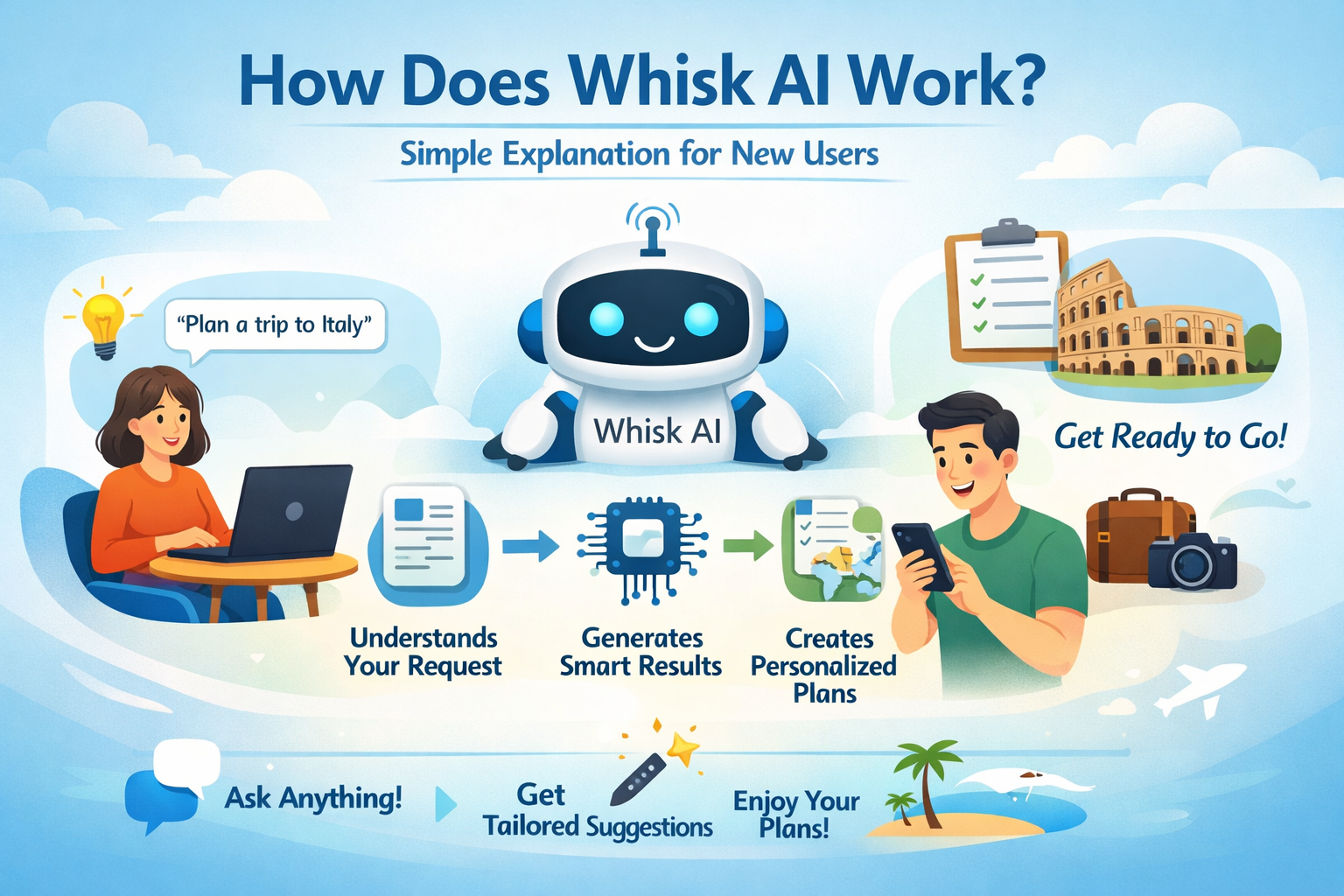
Here’s the simplest way to understand how Whisk AI works.
Step 1: You Describe an Idea
You write a short description — what’s in the image, the mood, or the setting.
Step 2: Whisk AI Interprets Your Words
The system looks at:
-
Objects (mountains, people, buildings)
-
Mood (calm, dramatic, warm)
-
Style (realistic, artistic, cinematic)
It doesn’t “think” like a human — but it recognizes patterns from millions of visual examples.
Step 3: The Image Is Generated
Within seconds, Whisk AI creates a visual interpretation of your idea.
⚠️ Important note from experience:
Whisk AI interprets meaning, not perfection.
That’s why wording matters — a little.
Why Whisk AI Feels Easier Than Other AI Tools
One thing I noticed immediately is that Whisk AI doesn’t punish beginners.
You can:
-
Use simple language
-
Make mistakes
-
Try again without stress
Some AI tools feel like exams.
Whisk AI feels more like a sketchbook.
That’s why many beginners stick with it.
Writing Prompts (Without Overthinking)
Here’s something I learned the hard way:
Long prompts don’t mean better images.
The best prompts usually include:
-
One main subject
-
One environment
-
One mood
Example that worked well:
“A small wooden cabin in the forest during early morning fog.”
No fancy words.
No technical phrases.
And yes — this is how Whisk AI works best.
Styles: Small Changes, Big Results
Whisk AI allows different visual styles, but beginners should keep it simple.
From real testing:
-
“Realistic” → safer starting point
-
“Cinematic” → more dramatic lighting
-
“Cartoon” → playful, illustrated feel
Changing just one word like soft to dramatic can change the entire image.
This is where learning happens naturally.
Templates Help More Than You Think
If you ever feel stuck, templates are extremely helpful.
They:
-
Give structure to your ideas
-
Reduce guesswork
-
Improve consistency
You can explore them here:
Whisk AI Templates Guide
Templates don’t limit creativity — they guide it.
Learning by Looking at Examples
One of the fastest ways I learned was by observing examples.
Seeing how others adjusted:
-
Lighting
-
Mood
-
Scene details
…helped me understand how Whisk AI “reads” language.
You can browse real examples here:
Whisk AI Examples
Common Beginner Mistakes (We All Make Them)
Let me save you some time.
Most beginners:
-
Write overly long prompts
-
Expect perfect realism on the first try
-
Change too many things at once
-
Copy prompts without understanding them
The fix is simple:
Change one thing at a time.
That’s how you learn how Whisk AI works.
Is Whisk AI Safe to Use?
Yes — when used responsibly.
A few personal rules I follow:
-
AI images are creative visuals, not proof
-
Always review before publishing
-
Avoid misleading or harmful content
Google’s own guidance is useful here:
Limitations (Let’s Be Honest)
Whisk AI is powerful — but not perfect.
-
Complex scenes may need multiple tries
-
Small details can look odd sometimes
-
AI interprets meaning, not reality
That’s normal — and expected.
Why Whisk AI Matters in 2026
In 2026, visuals are everywhere.
Whisk AI helps beginners:
-
Create images without design skills
-
Save time
-
Learn visually
-
Experiment creatively
And most importantly — it lowers the barrier to creativity.
Final Thoughts (From Real Use)
If I had to sum it up in one line:
Whisk AI works best when you treat it like a creative partner, not a magic button.
Start simple.
Experiment slowly.
Enjoy the process.
That’s how real results happen.